
Two Designers walk into a bar (A.K.A. Contrast Masking)
Two designers walk into a bar and sit down with their Powerbooks. One designer says to the other, "How much you want to bet I can correct the highlight and shadow of this image without using any adjustment tools or filters directly on the image?
The other designer takes him up on the bet and a minute later begrudgingly hands his associate $10.
How did the first designer win the bet?
The designer used a contrast mask to adjust his highlights and shadows. You can too by following these simple steps.
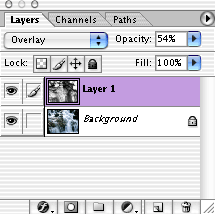
1. Open and image that has plugged shadows and/or blown out highlights
2. Duplicate that layer (Command + J)
3. Desaturate the duplicated layer (Shift + Command + U)
4. Invert the duplicated layer (Command + I)
5. Change the duplicated layer's blend mode to Overlay
The contrast mask with reduce the blown out highlights and open up the plugged shadows. You can then of course make further adjustments by changing the duplicated layer's opacity, changing the blend if settings in the Layer Style dialog box or by adding a layer mask to isolate areas.
- crhoadhouse's blog
- Login or register to post comments


Nice tip
Contrast masking is one of the techniques I use the most. I guess I am a bad photographer. One thing that I would like to add is that I usually after inverting the duplicate layer I apply a gaussian blur to it. I find that I get much better results by doing this.
One other thing that I sometimes do is that I use the Tachyon Filter ( a free plugin by flaming pear) instead of desaturating and inverting. This filter inverts the dark and bright areas of the pictures without changing hues. I find that it can give some interesting results.
Ahh yes
D'oh forgot the blur step...must stop drinking so early in the morning.
Thanks for the tip on the Tachyon Filter I'll have to check it out. But could'nt you get the same result changing the mode to LAB and inverting the Lightness channel?
Then that got me thinking about doing it all in LAB mode, duplicating the layer inverting the Lightness channel and changing the mode to overlay. And it did the same as the old method at a lower layer opacity and also gave the colors a little extra kick in the ass.
Then I tried it on a 16 bit image in LAB mode and could really pull out some great detail in the shadows.
God I need a life...
Thanks for the comment.
Nice
I like tips like these...I'm not really a photographer but use photos that look strung out in my designs all the time..and I always spend way too much time trying to make them look good. So, this tip will help with those bad shadow photos. Thanks.
Great tip and I like the way
Great tip and I like the way you presented it! :D
Isn't this called 'Unsharp
Isn't this called 'Unsharp Mask'?
Perhaps you're thinking of high pass sharpening
That's when you duplicate a layer, apply the highpass filter on it (Filter>Others>High Pass) then desaturate (command+u) and then change that layers blend mode to hard light.
I like this method because you can adjust the amount of sharpening by varying the highpass layer's opacity, increase sharpening by duplicating the high pass layer, you could also add a layer mask to the high pass layer to have targeted sharpening.
Simple menu commands are fine and dandy, but when you want Absolute Dictorial Control you gotta go with layers :)
"Isn't this called 'Unsharp?"
No.
It is called Shadow?Highlight under Image/Adjust. :)